Wix Payments KYC form
Improving KYC form completion for Wix Payments
Overview
The Wix Payments KYC form was a critical step in the onboarding journey because users had to complete it before they could start accepting payments and receiving payouts. This project focused on improving the content in that form to reduce friction, increase trust, and help more users complete verification successfully. The result was an increase in KYC form completion of around 3.5 percent.
Context
To use Wix Payments, users first had to verify that they were who they claimed to be. That verification happened through the KYC form, which asked for personal information and played a key role in whether a user could move forward in accepting payments through Wix Payments. Because the form sat between connection and activation, completion rate was directly tied to payment adoption and business growth.
Problem
The KYC form was one of the most difficult parts of the Wix Payments onboarding flow. Users were being asked to spend time filling out a form and provide sensitive personal information, which naturally created hesitation and drop-off. In a payments context, this kind of friction is expected to some degree, but the writing needed to make the experience feel clearer, more trustworthy, and less overwhelming. Fintech onboarding often succeeds or fails based on how well it explains necessary friction and reduces abandonment.
Goals
This project had two connected goals:
-
User goal: help users understand what was being asked, why it was needed, and how to complete the form without delays.
-
Business goal: increase KYC form completion so more connected users could become active Wix Payments users.
My role
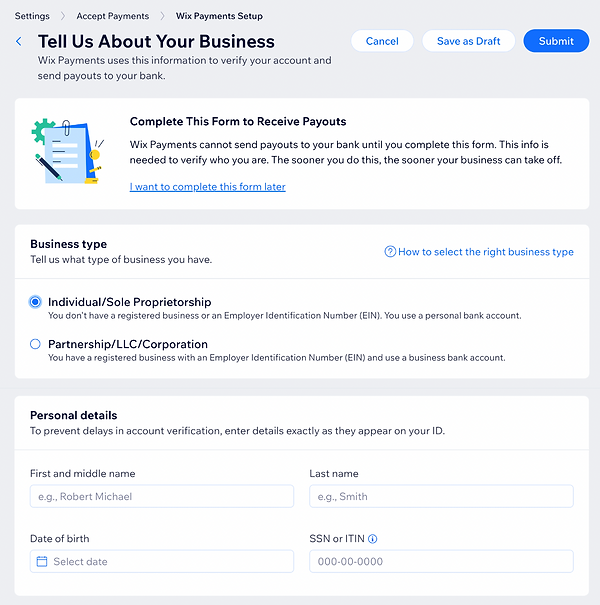
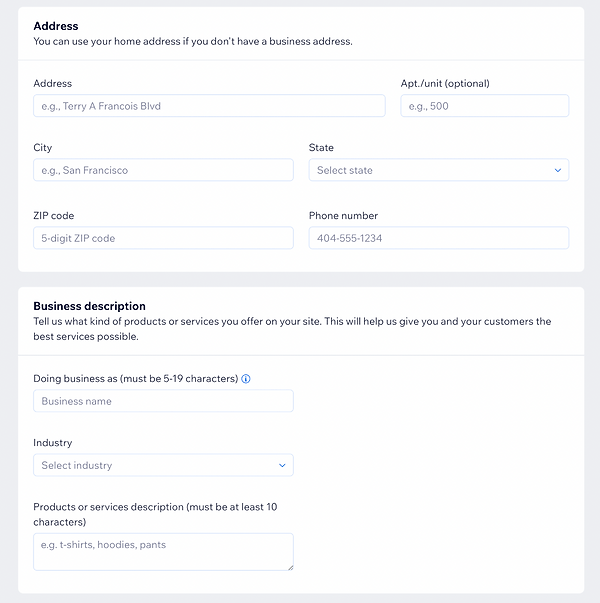
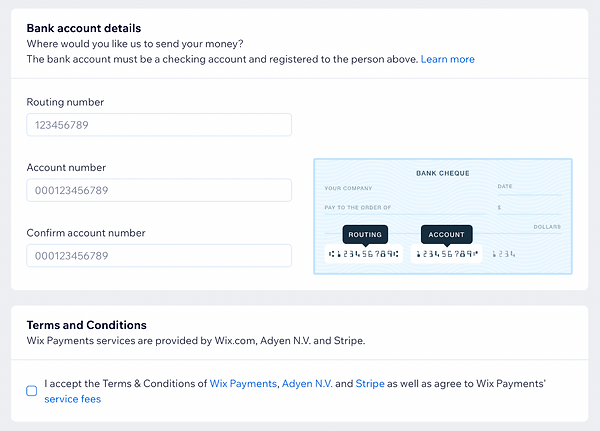
As UX Writer for Wix Payments, I reworked the form content to improve clarity and completion. This included simplifying the copy, making the tone more approachable, clarifying why the requested information was necessary, and using subtitles to proactively prevent common mistakes that could slow approval.
Challenges
The core challenges were straightforward but important:
-
The form took time to complete.
-
It asked for personal information, which naturally raised user sensitivity and hesitation.
-
Small mistakes could delay approval, increasing frustration and reducing trust.
Content strategy
To improve completion, I focused on four main writing principles:
1. Keep it short
I reduced unnecessary friction by keeping the copy concise and avoiding overly dense or formal explanations.
2. Make it friendly
I used a more human, approachable tone to make a compliance-heavy step feel less intimidating.
3. Explain why the information was needed
Instead of only asking for sensitive details, the content gave users context about why Wix needed the information, helping reinforce trust and legitimacy.
4. Prevent common mistakes
I used subtitles and supporting microcopy to highlight common errors and set better expectations, which helped reduce avoidable approval delays.
Solution
The updated KYC form content made the experience feel shorter, clearer, and more trustworthy without changing the core compliance requirements. Rather than trying to remove necessary friction, the writing was designed to make that friction easier to understand and complete successfully. This is often the real challenge in fintech UX: not eliminating compliance steps, but helping users move through them with confidence
Outcome
After the content rework, KYC form completion increased by around 3.5 percent. That change was especially meaningful because it happened alongside improvements to the Connect Payments page that had already increased Wix Payments connections by almost 15 percent. Together, these content changes helped grow the number of users successfully entering and progressing through the Wix Payments onboarding funnel.
Reflection
This project reinforced an important UX writing principle: users are more willing to complete sensitive tasks when the product respects their time, explains its intent clearly, and helps them avoid mistakes before they happen. In a KYC flow, clarity and trust are not just content qualities; they are conversion levers.